
 Products
Medically reviewed by Debra Jaliman, MD, Board-Certified Dermatologist. Last updated November 2026
Dr. Debra Jaliman is a board-certified dermatologist and Assistant Clinical Professor of Dermatology at the Icahn School of Medicine at Mount Sinai who has personally performed Botox injections in NYC since 1992. With more than three decades of experience treating thousands of patients, she personally evaluates each patient and performs every Botox injection herself, tailoring the dose and placement to individual facial anatomy, muscle strength, expressions, and aesthetic goals.
Botox Injections Personally Performed by Dr. Jaliman
Every Botox treatment is customized to the individual. Some patients prefer to maintain more facial movement, while others want a smoother appearance. Dr. Jaliman adjusts the dose and injection placement to soften wrinkles while preserving natural facial expression. Her goal is a refreshed appearance, not a frozen or overtreated look.
Botox Cosmetic is an FDA-approved prescription injectable that temporarily relaxes targeted muscles to reduce the appearance of wrinkles caused by repeated facial expressions. It is commonly used to treat frown lines between the eyebrows, crow’s feet, and forehead lines, with results typically lasting three to four months.
What is Botox, and how does it smooth lines?
Botox Cosmetic (onabotulinumtoxinA) is a prescription injection that temporarily relaxes specific muscles that wrinkle the skin when you frown, squint or raise your eyebrows. Less muscle movement means softer lines, and results usually last three to four months.
Lines that appear with expression are called dynamic lines, and they are what Botox treats. Lines that stay visible at rest are static lines. Botox can soften static lines after repeated treatments, but deeper static lines may also need filler or resurfacing. Botox does not add volume, lift sagging skin or change skin texture.
Botox Cosmetic is FDA-approved for four cosmetic areas: frown lines between the brows, crow's feet, horizontal forehead lines and vertical neck bands. Other treatment areas, including the jaw muscles, chin and corners of the mouth, are common off-label uses. These treatments require a thorough understanding of facial anatomy, careful patient selection and precise injection technique to achieve natural-looking results while minimizing the risk of complications.
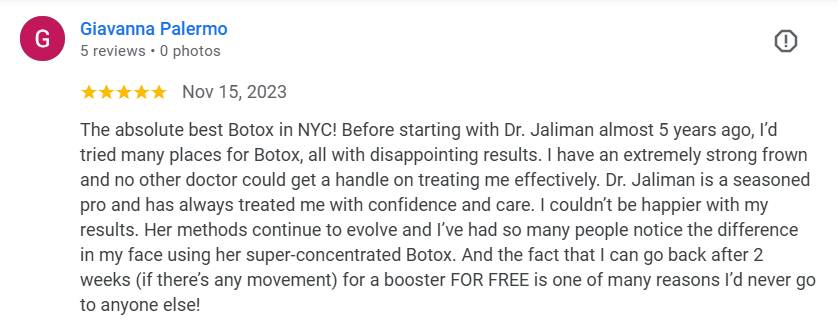
See What Patients Say About Dr. Jaliman's Botox
Botox Before and After Results for Frown Lines Show How Precise Injections Can Smooth Deep Wrinkles.


Botox before and after results for frown lines treated by Dr. Debra Jaliman, NYC
More Botox Results for Forehead Lines
Consistent, natural-looking results are key when treating forehead lines. Here is another example of Botox smoothing deep lines while preserving natural movement.


Additional Botox before and after results for forehead lines treated by Dr. Debra Jaliman in NYC
Why do Botox results look so different from one NYC injector to the next?
The same Botox product can produce natural results in one practice and an unwanted heavy brow or frozen expression in another. The difference often comes down to four things: dilution, a thorough understanding of facial muscle anatomy, precise injection into the correct muscles, and individualized dosing.
Does Botox dilution affect how natural the results look?
Botox Cosmetic arrives as a powder that must be reconstituted with sterile saline before injection.
The FDA prescribing information describes mixing a 100-unit vial with 2.5 mL of saline. Dr. Jaliman customizes Botox dilution based on the strength of the muscles being treated. She uses both a 1 cc and a 2.5 cc dilution, selecting the concentration according to the individual muscle and treatment area. This allows her to tailor treatment to each patient's facial anatomy and muscle activity.
A more concentrated solution delivers the intended number of units in a smaller volume of fluid.
However, dilution alone does not determine the outcome. Precise injection placement, appropriate dosing, muscle strength, and individual facial anatomy all contribute to achieving natural-looking results.
There is no single dilution that is right for every area of the face. Dr. Jaliman evaluates each patient individually to determine the appropriate approach.
Why do some injectors use the same injection points on every face?
No two faces move exactly alike. A standard injection pattern may be convenient, but it doesn't account for differences in muscle strength, facial anatomy, or expression.
Before treatment, Dr. Jaliman asks patients to frown, squint, smile, and raise their eyebrows. By observing how the facial muscles contract, she can identify which muscles are responsible for the lines and determine the appropriate injection points and dosage.
This individualized approach is particularly important for patients who have had Botox elsewhere but still notice persistent lines.
Sometimes a muscle has been missed, or the dose was insufficient to achieve the desired result.
Can Botox preserve facial expression for people who work on camera?
Absolutely. The goal is to soften unwanted lines without eliminating the facial movement that makes someone look natural and expressive.
For patients who work on camera, Dr. Jaliman takes particular care to preserve eyebrow movement and natural expression around the eyes.
She can use smaller, strategically placed doses to soften lines while maintaining enough muscle movement for the face to remain expressive on screen.
Who actually performs your Botox injections?
At some practices, a nurse practitioner or physician assistant performs the injections while the physician sees other patients. At Dr. Jaliman's practice, she personally performs every Botox injection, from the initial treatment through subsequent visits.
She also personally evaluates patients at the two-week follow-up and makes any necessary adjustments. This continuity allows her to assess how each patient's muscles responded and refine the treatment when needed.
Table of Contents
Botox Treatment Areas
Which areas of the face and neck can Botox treat?
Can Botox soften frown lines between the brows? Yes. The vertical "11" lines come from two muscles that pull the brows together, and Botox Cosmetic is FDA-approved for them. See Botox for Frown Lines.
What does Botox do for forehead lines?
It relaxes the muscle that lifts the brows. Too much product here lets the brows sit lower, so Dr. Jaliman balances the forehead against the frown muscles below it.
Does Botox help crow's feet?
Yes. It softens the lines at the outer corners of the eyes while keeping a natural smile. See Botox for Crow's Feet.
What are bunny lines?
Diagonal lines on the sides of the nose that appear when you smile or scrunch. A few small injections soften them.
What is a Botox lip flip?
A few units along the upper lip let it roll outward slightly, so it looks fuller without filler. Many patients combine it with a small amount of lip filler.
Can Botox soften lines around the lips?
Yes, vertical lip lines can be softened with very small doses that keep normal speech and eating.
Can Botox smooth neck bands?
Yes. Relaxing the platysma muscle softens vertical neck bands and can sharpen the jawline, sometimes called a Nefertiti lift.
Can Botox lift downturned mouth corners?
Yes, when a small muscle called the depressor anguli oris pulls the corners down. See DAO Botox: how a few units lift downturned mouth corners.
Can Botox give a brow lift?
A small, non-surgical lift is possible by relaxing the muscles that pull the brow down.
What does masseter Botox do?
It relaxes the chewing muscles, which can ease clenching and grinding and slim a square jaw over two to three months. See Masseter Botox in NYC.
Can Botox smooth a dimpled chin?
Yes. Relaxing the mentalis muscle smooths an "orange peel" chin. See how Botox smooths a dimpled or pebbled chin.
Does Botox help jowls?
Only partly. Botox can reduce the downward pull of the neck muscle, but it does not lift loose skin. See Does Botox help jowls? and skin tightening.
Can Botox reduce underarm sweating?
Yes, for several months at a time. See Botox for excessive sweating. Several areas can be treated in one visit.
Who Is a Good Candidate for Botox?
Who is a good candidate for Botox, and who should wait?
Botox is appropriate for many healthy adults who want to soften wrinkles caused by repeated facial expressions. It is particularly effective for dynamic lines that appear when you frown, squint, or raise your eyebrows. Even if lines have become visible at rest, Botox can help relax the underlying muscles and prevent them from becoming more pronounced.
Deeper, established lines may also benefit from complementary treatments such as dermal fillers or laser resurfacing. Botox can be part of a treatment plan that includes these procedures.
How do I know if I need Botox yet?
Look in the mirror at rest and then make facial expressions. If lines appear only when you frown or raise your eyebrows, they are primarily dynamic and may respond very well to Botox. If lines remain visible when your face is relaxed, they have become more established. Botox can still help soften them and prevent further deepening, although additional treatments may be needed for the best result.
A consultation helps determine the right timing and treatment approach. Dr. Jaliman will also tell you if waiting is the better choice.
Is preventative Botox in your 30s worth it?
For people with strong frown muscles or who frequently raise their eyebrows, preventative Botox can be worthwhile. Small, carefully placed doses reduce repetitive muscle contractions that contribute to wrinkle formation over time. The goal is to soften expression lines while preserving natural facial movement so that nobody can tell you have had anything done. See Preventative Botox in your 30s.
How is Botox different for men?
Men generally have stronger facial muscles and may require more units of Botox to achieve the desired result. Treatment is customized to muscle strength and facial anatomy.
The goal is a refreshed, rested appearance while preserving masculine features and natural expression. See Men's Botox in NYC.
Who should not get Botox?
Botox should not be given to anyone with a known allergy to a botulinum toxin product or an infection at the proposed injection site. Treatment is generally avoided during pregnancy and breastfeeding because safety has not been established. People with neuromuscular conditions such as myasthenia gravis, ALS, or Lambert-Eaton syndrome require careful medical evaluation before treatment.
Patients should also tell Dr. Jaliman about any medications they take, including blood thinners, and any previous reactions to Botox or other neuromodulators. See who should not get Botox.
Botox Costs in NYC: Transparent Pricing
Pricing is straightforward, with no hidden fees.
Consultation: $250, applied toward same-day treatment or a future appointment.
Treatment: Priced by area, not by unit. Exact pricing is discussed at consultation based on each patient’s treatment areas and goals.
Complimentary two-week follow-up: Included with every treatment for evaluation and touch-ups if needed.
Risks of Discount Botox
Not all Botox in NYC is the same. Deep discounts can signal diluted or counterfeit product, improper storage, or injections by inexperienced or unlicensed providers. Learn more about the risks of fake Botox and illegal fillers.
How to Prepare for a Botox Appointment
To minimize bruising, patients should avoid aspirin, ibuprofen, fish oil, vitamin E, and alcohol for one week before treatment. Those taking prescribed blood thinners should discuss this with Dr. Jaliman first and should never stop a prescription without consulting their physician. Scheduling Botox at least two weeks before a major event allows full results to develop. See the complete guide on how to prepare for Botox.
Botox, Dysport or Xeomin: which do I need?
All three are botulinum toxin type A and relax muscles the same way. They differ in formulation and in how many units equal one Botox unit, so doses are not interchangeable.
Xeomin has no accessory proteins, which some doctors consider when a patient seems to respond less to another product over time. Dr. Jaliman offers all 3, and will recommend one based on your history. See Xeomin page and Botox vs Xeomin.
What happens at a Botox appointment with Dr. Jaliman?
Your first visit begins with a 15-minute consultation with Dr. Jaliman. She evaluates your face both at rest and in motion, discusses the areas that concern you, and explains what Botox can and cannot accomplish. She develops an individualized treatment plan based on your facial anatomy, muscle strength, and aesthetic goals. If dermal fillers, laser treatments, or no treatment at all would be a better option, she will tell you.
How should I prepare for my Botox appointment?
To help minimize bruising, avoid aspirin, ibuprofen, fish oil, vitamin E, and alcohol before treatment if medically appropriate and approved by your prescribing physician.
Never stop prescribed aspirin or blood thinners without consulting your doctor. If you have an important event coming up, schedule your Botox appointment at least two weeks in advance to allow time to see the full results.
How does Dr. Jaliman help prevent bruising?
Bruising can occur when a needle passes through a small blood vessel. Before injecting, Dr. Jaliman uses a Veinlite, a specialized light that helps visualize superficial blood vessels beneath the skin so she can avoid them when possible.
Although bruising cannot be eliminated entirely, this additional step helps reduce the risk. If bruising does occur, certain in-office light or laser treatments may help it resolve more quickly. See how to stop bruising after Botox.
Does Botox hurt?
Most patients describe Botox injections as a quick pinch. To make treatment more comfortable, Dr. Jaliman uses a Zimmer chiller, which directs a stream of cold air onto the skin during injections.
Numbing cream is also available for patients who are particularly sensitive.
How long does the injection take?
The actual injections generally take about 15 to 20 minutes. There is no significant downtime, and most patients return to work or their regular activities immediately afterward.
What side effects are normal after Botox?
Mild redness or slight tenderness at the injection sites is common and typically resolves within a few hours. Most patients return to normal activities the same day.
What should I avoid after Botox?
Remain upright for the first hour after treatment. Avoid touching, rubbing, or massaging the injection sites for 24 hours, and skip strenuous exercise, saunas, and hot yoga during that time. See Botox aftercare do's and don'ts for a day-by-day timeline and skincare tips.
What happens at the two-week follow-up?
Dr. Jaliman sees you approximately two weeks after treatment, when the Botox results can be evaluated. She checks how your muscles have responded and whether the desired result has been achieved. If an adjustment is needed, she provides additional Botox at no charge.
Starting with a conservative dose allows Dr. Jaliman to assess your individual response before making any necessary adjustments. The complimentary touch-up is part of your original treatment, you do not pay again.

Real Botox Results for Crow’s Feet
One of the most common treatment areas for Botox is crow’s feet around the eyes. With precise placement, Botox smooths fine lines while preserving natural facial movement. Below is a real patient result from treatment performed by Dr. Debra Jaliman in NYC.


Botox NYC before and after results for crow’s feet, treated by board-certified dermatologist Dr. Debra Jaliman at her Upper East Side Manhattan practice
Botox: Frequently Asked Questions
Q. Who is the best board-certified dermatologist for Botox in NYC, rather than a med spa?
Look for a board-certified dermatologist who injects every patient personally, explains the dose before injecting and sees you again at two weeks. Dr. Debra Jaliman has injected Botox in Manhattan since 1992, performs every injection herself and is Assistant Clinical Professor of Dermatology at Mount Sinai.
Q. Is Botox safe?
Botox Cosmetic has been FDA approved for cosmetic use since 2002 and is one of the most studied cosmetic treatments. It is safest when injected by a physician who knows facial anatomy, uses a genuine product from an authorized supplier, and doses each patient individually.
Q. Does Dr. Jaliman do the Botox injections herself?
Yes. Dr. Jaliman performs every Botox injection at her practice herself. No nurse practitioner or physician assistant injects.
Q. How much does Botox cost in NYC?
Botox pricing in NYC varies with the injector's training and experience, the practice's location, and how the practice charges. Some offices charge per unit, while others charge per treatment area. Dr. Jaliman charges by area, so your price is based on what is being treated, such as frown lines or crow's feet, and you know the cost before the treatment begins. Every injection at the practice is performed by Dr. Jaliman herself, a board-certified dermatologist, rather than a nurse injector. At your consultation, she evaluates your face and gives you the cost of your treatment plan. If an adjustment is needed at your two-week visit, it is included.
Q. How many units of Botox will I need?
The number of units varies by treatment area, muscle strength, and individual anatomy. As a general guide, most patients require the following ranges:
Forehead lines: 10–50 units. Frown lines (glabellar “11s”): 20–50 units. Crow’s feet: 10–20 units per side. Brow lift: 5 units per side. Lip flip: 4–6 units. Neck bands: 25–50 units depending on severity. Masseter jaw slimming: 25–50 units per side.
Men typically require more units than women due to greater muscle mass and strength. Younger patients receiving preventative Botox may require fewer units than patients treating established lines.
During your consultation, board-certified dermatologist Dr. Jaliman evaluates your muscle activity and facial structure to recommend precise dosing tailored to your anatomy and aesthetic goals, ensuring natural, balanced results without over-treatment.
Pricing at her practice is by area rather than by unit, so you know exactly what to expect before your appointment.
Q. Does Botox dilution affect how natural it looks?
It can. Dilution controls how much fluid carries each unit, which affects how concentrated the dose is at the injection point and how far it spreads. Dr. Jaliman chooses the dilution based on the strength of the muscle being treated, using either 1 mL or 2.5 mL of saline per 100-unit vial. The 2.5 mL dilution is the one listed on the Botox Cosmetic label. She usually uses the more concentrated 1 mL mix for strong frown muscles, and sometimes for forehead lines. The number of units and where they are placed still matter most.
Q. Will my face look frozen?
Not usually, when the dose is planned for your face. Frozen results come from too much product or poor placement. Dr. Jaliman starts conservatively and adjusts at two weeks.
Q. Does Botox hurt?
Most people feel a brief pinch. A Zimmer chiller numbs the skin with cold air during each injection, and numbing cream is available.
Q. How do I avoid bruising from Botox?
Skip blood-thinning supplements and alcohol for 24 to 48 hours beforehand if your doctor agrees. Dr. Jaliman uses a Veinlite to see and avoid vessels before injecting.
Q. Can I start with a small amount and add more later?
Yes. Dr. Jaliman starts light and sees you at two weeks; additional units at that visit are included.
Q. How long does Botox last?
Usually three to four months. Results appear in three to five days and are complete at two weeks. Most patients repeat treatment every three to four months, once movement starts to return. See: How Often Do You Need Botox?
Q. My Botox wore off after six weeks. Is that normal?
No, that is early. Botox usually lasts three to four months. When it fades much sooner, the cause is usually the dose, the injection points, or how the product was placed. If you were treated elsewhere and your muscles are moving fully again, Dr. Jaliman evaluates your face and treats you from the start with a plan based on your own muscle strength and anatomy.
Q. Should I start preventative Botox in my 30s?
It depends on what your lines do when your face is at rest. If lines appear only when you frown, squint, or raise your brows, a small dose can relax those muscles and help keep the lines from settling in. Waiting is also reasonable at that stage. If lines stay after you relax your face, they have started to set, and Botox will soften them. Dr. Jaliman evaluates your muscle movement and skin at your consultation and recommends whether to start now or wait. Learn more about Preventative Botox
Q. Is Botox different for men?
Men usually need more units of Botox because their facial muscles are stronger. The aim is still a natural, rested look that keeps expression. Read more about Botox for Men
Q. How do I know if Botox or dermal fillers are right for me?
Botox and dermal fillers address different concerns and are often most effective when used together.
Understanding the distinction helps clarify which treatment, or combination, is right for you.
Botox works by relaxing the muscles that cause dynamic expression lines, wrinkles that appear when you frown, squint, or raise your eyebrows.
It is most effective for forehead lines, frown lines, crow's feet, and other areas where repeated muscle movement is the primary cause of wrinkling.
Dermal fillers work by restoring lost volume beneath the skin. They are most effective for static lines that are visible even at rest, such as nasolabial folds and marionette lines, as well as for volumizing the cheeks, lips, jawline, and under-eye hollows where tissue loss has occurred with age.
Many patients benefit from both treatments in the same appointment. In the glabellar area, for example, Botox first relaxes muscle movement while filler corrects the deeper crease that persists at rest, producing more complete results than either treatment alone.
To learn more about dermal filler options, visit our Dermal Fillers NYC page.
Q. Can Botox be combined with other cosmetic treatments?
Yes. Botox can be safely combined with dermal fillers, laser treatments, and chemical peels to enhance overall facial rejuvenation. Dr. Debra Jaliman often customizes combination treatments to achieve natural, balanced, long-lasting results.
Book a Botox consultation on the Upper East Side
You should leave a Botox appointment looking like yourself on a good day. That takes a plan made for your face, a doctor who injects it herself, and a second look at two weeks.
Dr. Jaliman has been injecting Botox since 1992. At your consultation at 931 Fifth Avenue, she looks at your whole face, not only the line that brought you in, and tells you what will and won't help. The $250 consultation fee is credited in full toward a treatment booked within 3 months.
Book a consultation with Dr. Jaliman or call .


